
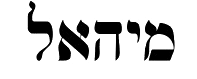
Angel no. 48
Miyhe'el
«I understand the manifestations of the invisible»
Miyhe'el belongs to the Virtues and accompanies the period from 18 to 22 November. The motto «I understand the manifestations of the invisible» evokes the possibility of recognising and integrating parts of yourself that common expectations keep separate.
Your gift is to unite qualities considered opposites: initiative and receptiveness, the ability to give and the willingness to receive, strength and sensitivity. This portrait uses the masculine and feminine as images of that integration. You may recognise yourself in ways of being different from those your surroundings expect, and find a personal form for expressing them.
The main obstacle is conformity. You may spend a great deal of time trying to resemble those who seem to fit in effortlessly. Meanwhile, you feel something remains excluded: a desire, an interest, a way of loving or presenting yourself. The effort to appear acceptable can make you uncertain even when you know clearly what you feel.
In love, you seek a deep affinity. Desire can draw you towards a person, but you need the encounter to welcome your way of feeling and thinking too. If you choose only to fit a model, you may experience disappointment, resignation and a sense of playing a part. As you recognise yourself more fully, you can express what you want more honestly and listen to the reality of the relationship.
The symbolic comparison with Yesale'el highlights a similar experience of integration and self-discovery. The direction that follows differs in the two portraits: Yesale'el tends to turn it into personal assertion, Miyhe'el above all into a need for liberation. This connection may help you recognise the desire to stop living according to an inherited script.
A turning point may develop through an encounter, a disappointment, a change of place or work, an ideal embraced or a conviction abandoned. Suddenly, what once seemed inevitable becomes open to question. You regain energy because you no longer have to use it all trying to hide, and begin to imagine larger projects.
Martin Luther, Voltaire and Charles de Gaulle represent passages from subordination to an ability to challenge and liberate. Robert Kennedy evokes a desire for political change. Nadine Gordimer brings the confrontation with apartheid and the colonial mindset; René Magritte, the liberation of imagination through surrealism. These are different forms of the same impulse: giving public expression to something that previously found little space.
Jodie Foster, in the role of the exploited young girl in Taxi Driver, evokes being imprisoned in an imposed role and breaking that constraint. The image allows recognition of the weight of an alien role while keeping distinct the concrete severity of the violence suffered by the character.
After a personal discovery, your work may also seem unsuitable. You may find a passion to develop initially in your free time and grow into an occupation. Or you can keep your present job, changing some aspects of it and creating new space elsewhere. What matters is that security does not become a reason to suppress everything you have recognised again.
The risk is retreating out of fear of your own initiative, curbing the possibilities you have opened for others too. Luther returns as an example of the tensions between renewal and control over how it develops. Charles I of England, in turn, evokes the difficulty of reading and accepting changes already under way.
Your direction is to keep opening up freedom through workable decisions and responsibility. In relationships, you can seek equality, exchange and mutual freedom. Through work and ideals, you can offer younger generations an example of authenticity: a life in which the different parts of you find room and change remains possible.